The Need for Stronger Engagement with the ICCPR
The United States often positions itself as a global defender of human rights, but its approach to the International Covenant on Civil and Political Rights (ICCPR)—a fundamental human rights treaty under the United Nations—raises critical questions about the depth of this commitment. While the U.S. ratified the ICCPR in 1992, a treaty that guarantees essential rights such as freedom from arbitrary detention, the right to a fair trial, and protection from torture, its handling of the treaty suggests a reluctance to fully integrate these protections into its domestic legal system. The U.S. can and should do better.
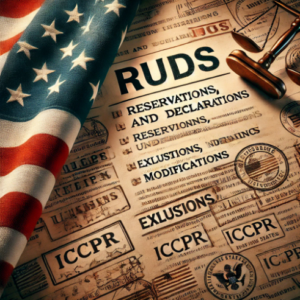
Compared to many other developed nations, the U.S. has taken a noticeably more cautious—some might say restrictive—approach to the ICCPR. Through numerous Reservations, Understandings, and Declarations (RUDs), the U.S. has limited the direct applicability of the treaty in its legal framework. While some of these reservations align with U.S. constitutional principles, they have led to concerns that America’s commitment to international human rights is selective and, at times, superficial.
The Non-Self-Executing Declaration: A Missed Opportunity
One of the most significant decisions the U.S. made upon ratification was declaring the ICCPR non-self-executing. This means that, despite the U.S.’s formal acceptance of the treaty, its provisions cannot be directly enforced in U.S. courts without additional legislation from Congress. As a result, many of the rights protected under the ICCPR are not legally binding within the United States, leaving the treaty’s impact on U.S. law largely symbolic.
This cautious approach stands in contrast to other countries that have incorporated the ICCPR into their domestic legal systems, making it a part of the “supreme law of the land.” While the U.S. has its own robust legal protections, its reluctance to fully integrate the ICCPR is a missed opportunity to strengthen human rights protections for all individuals within its borders. By failing to make the treaty self-executing, the U.S. has, in effect, placed critical human rights principles out of reach for those who might need them most.
U.S. Reservations: Holding Back on Key Rights Protections
The U.S. has attached several reservations to the ICCPR that limit the extent of its obligations under the treaty. These reservations often prioritize domestic law over international human rights standards, creating a gap between U.S. commitments abroad and the protections available at home.
Death Penalty: Out of Step with Global Trends
The U.S. reserved the right to continue using the death penalty, despite international calls for its abolition. Although the Supreme Court has since prohibited the execution of individuals for crimes committed under the age of 18 (Roper v. Simmons, 2005), the U.S. remains one of the few developed nations that still employs capital punishment. This reservation highlights a stark divergence from global human rights trends, and the U.S. continues to lag behind its peers in abolishing this practice altogether. The U.S. could lead the world by taking stronger action to eliminate the death penalty, a punishment increasingly viewed as incompatible with modern human rights standards.
Cruel, Inhuman, or Degrading Treatment: A Narrow Interpretation
The U.S. also interprets the ICCPR’s prohibition on cruel, inhuman, or degrading treatment through the narrower lens of the U.S. Constitution, specifically the Eighth Amendment. This allows practices like prolonged solitary confinement or certain interrogation techniques to persist, despite international human rights bodies frequently condemning them. While the U.S. may argue that its interpretation is consistent with constitutional standards, the reality is that this reservation leaves room for human rights violations that other developed nations have chosen to categorically prohibit.
Free Speech and Hate Speech: A Balancing Act
Another key reservation involves the U.S.’s refusal to accept Article 20 of the ICCPR, which prohibits war propaganda and the advocacy of racial or religious hatred. Citing First Amendment concerns, the U.S. has maintained that these types of speech, however offensive, are protected under its Constitution. While free speech is a cornerstone of American democracy, this reservation leaves the U.S. as an outlier among many of its peers, where more stringent laws against hate speech are seen as essential to preventing violence and protecting marginalized groups. The U.S. can find a better balance between protecting free speech and curbing harmful rhetoric that fuels division and violence.
Falling Short of Full Commitment
It is clear that the U.S. could do more to align its domestic laws with the human rights principles enshrined in the ICCPR. Other countries, including many democracies, have implemented the treaty’s provisions more comprehensively, giving their citizens direct access to its protections. By contrast, the U.S. approach has left many of these rights as aspirations, rather than enforceable guarantees. This disparity raises important questions about whether the U.S. is truly committed to protecting the full spectrum of human rights, or if it selectively adheres to international norms when convenient.
The Path Forward: A Call for Stronger Action
At Rights Across Nations (RAN), we believe that the true measure of a nation’s commitment to human rights lies not only in its rhetoric but in its actions. The U.S. has long been a vocal advocate for human rights on the global stage, yet its approach to the ICCPR shows that there is significant room for improvement. To be a genuine leader in human rights, the U.S. must take steps to integrate international human rights norms more fully into its domestic legal framework.
This includes removing or revisiting reservations that weaken critical protections, abolishing the death penalty in line with global trends, and ensuring that all individuals—regardless of their status—have access to the full range of rights protected by the ICCPR. By making the treaty self-executing and implementing legislation that reflects its provisions, the U.S. could ensure that human rights are not merely ideals but enforceable rights for all.
The U.S. has the potential to lead by example, but it must do more to align its actions with its principles. It is time for the U.S. to close the gap between its international human rights obligations and the protections it provides at home. In doing so, it can reaffirm its role as a true leader in the global fight for human dignity and justice.